


Think Digital NOW not Digital First for online weather

If you spend time in a television newsroom today, you’ll likely hear the phrase “digital first.” This expression embodies the expectation that reporters and producers should post breaking news on the station’s website and mobile app first while preparing for the next newscast on television.
Digital First isn’t a new term. Steve Buttry, who served as the Director of Student Media at the Manship School of Mass Communication at Louisiana State University, first popularized the phrase in his blog in 2011. And Digital First isn’t a new strategy for television stations. News managers have been striving to embed this practice within their teams for the last decade, encouraging them to promptly publish new information on the digital platforms that more consumers prefer.
Yet, the effectiveness of this approach is questionable when it comes to weather coverage. New research published by HellerWeather exposes a surprising gap in online weather coverage: updating the weather webcast seems to be an afterthought, even when there’s breaking weather in the local area. The study found that over 70% of TV station websites featured outdated weather updates clipped from live newscasts that aired several hours or days earlier. This contradicts the goal of a Digital First approach. Instead, it feels more like Digital Earlier Today or Digital Yesterday.
READ MORE > STUDY EXPOSES GAP IN TV STATION ONLINE WEATHER COVERAGE
Since a Digital First strategy isn’t resonating with local weather teams, it may be time to consider a new one. News managers should encourage a visionary approach that emphasizes the importance of keeping online weather content updated, words that inspire broadcast meteorologists to regularly monitor the recorded webcasts to ensure they remain relevant, a phrase that helps the meteorologists determine what to feature in the webcast so consumers always find the information they want to know and need to know. Something like…Digital NOW, with NOW being an acronym for Never Outdated Weather.
Work smarter, not harder
Buttry wrote, “Digital First means different priorities and processes for journalists.” This also applies to broadcast meteorologists, who must adapt their methods to align with the expectations of contemporary consumers, ensuring that there’s never outdated weather on the website or mobile app.
According to media audience consultant Dustin Block, “One of our big challenges with the weather team is helping them break out of nowcasting. Everything on local TV is produced for this moment and is almost immediately dated.” Traditional practices are not geared toward digital engagement. Weather hits produced for live television simply do not work on digital platforms where consumers view the content on demand. They might watch the weather video a few minutes after it has been uploaded to the server and published online or several hours later.
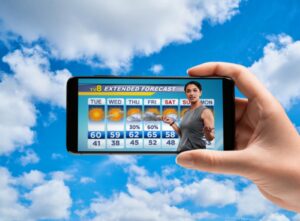 This delayed viewing requires broadcast meteorologists to carefully select content that won’t age out before the next recorded update. While that might seem like an easy task to an outsider, I can tell you from firsthand experience that it requires some mental gymnastics. Broadcast meteorologists are not accustomed to producing content this way, and it requires a significant shift in mindset. The weather teams at local TV stations must start thinking of themselves not as broadcast meteorologists but as multimedia meteorologists.
Keeping the webcast updated is especially crucial during developing situations, such as severe weather outbreaks, tropical cyclones, or wildfires. During these critical moments, people are actively seeking updated information to keep themselves and their families safe. By ensuring that the webcast contains relevant information, broadcast meteorologists can better assist the public in navigating these emergencies and developing a reputation as the go-to weather expert in their community.
READ MORE > 4 TYPES OF WEATHER CONSUMERS CARE ABOUT
Weather teams can’t implement a Digital NOW coverage strategy on their own. Fulfilling this obligation every day requires planning, coordination, and collaboration among various teams. Broadcast meteorologists must work closely with web managers to ensure recorded updates are promptly published online. Producers and content coordinators could assist in curating and managing the content that adds depth to the online coverage. The weather team must also synchronize with production control to record updates between newscasts or during commercial breaks. This comprehensive coordination ensures that all broadcast and digital teams work seamlessly together to provide consumers with engaging and relevant weather information no matter what screen they happen to be watching.
Social media in a digital world
The digital platform preferred by many broadcast meteorologists is social media. Most take great pride in the number of followers they have, and let’s be honest—it’s a bit of an ego boost. I suspect that if I were to check individual meteorologists’ social media pages, I would likely find more timely and detailed weather updates there compared to the webcast on the station’s website.
Building an online following is certainly valuable. It can help broadcast meteorologists develop meaningful connections with local viewers, fostering loyalty in the TV station they represent. However, the fickle nature of social media algorithms complicates this, making news content less visible in users’ feeds.
It’s important to note that more followers, likes, and shares on social media do not necessarily equate to increased traffic on the station’s official website or improved television ratings. The time spent engaging on social media mustn’t come at the expense of the station’s digital platforms—those that actually generate revenue and contribute to the bottom line.
Build a following by building trust
I tell my coaching clients that trust is built one storm at a time. Serve your viewers well, and they will return. When it comes to online weather coverage, trust is built one click or tap at a time. If someone goes through the effort of visiting the station’s website, navigating to the weather page, locating the webcast, and waiting for a pre-roll ad to play, the content in that webcast better be updated with relevant information. After all that, if they find outdated content instead, they are unlikely to watch another webcast in the future. Why would they?
The future for local broadcast television stations depends on building loyal audiences and establishing diversified revenue streams on both traditional broadcasting and newer digital platforms. To make that happen, local television station weather teams must always produce informative, compelling, and relevant content and guarantee that there’s Never Outdated Weather on the station’s website or mobile app.
HellerWeather provides guidance for local TV stations that want to establish a Digital NOW weather coverage strategy. Limited coaching opportunities are available through 2025. For more information: Talk to Tim.
Tim Heller is an AMS Certified Broadcast Meteorologist and Weather Communications Coach. He helps local TV stations and broadcast meteorologists communicate more effectively and work more efficiently.