


Social Media Vertical Video Case Studies
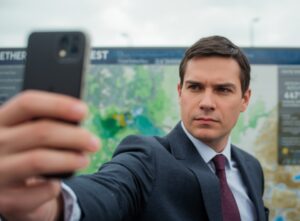
Among the social media content sought by young adults are updates on the weather. That’s according to new research conducted by SmithGeiger for Northeastern University. Yes, the reason people watch local TV news is also the reason people follow local news on social media.
This preference is reflected in the consistent growth and engagement many broadcast meteorologists are experiencing on Instagram and TikTok. Their achievements provide a clear roadmap for local television weather teams seeking to build stronger connections with their audience through social media.
Production Simplicity is Key
Vertical videos posted on social media don’t need to be extravagant or complicated. Meteorologist Trevor Gibbs, from WJAX in Jacksonville, FL, pulls a producer in from the newsroom to hold the camera while he delivers a short weather update in front of the video wall in the studio. Gibbs edits the videos using TikTok and reposts them on Instagram. Simple, yet effective.
Meteorologist Lee Goldberg from WABC in New York City, also relies on a producer to help him record his daily Quickcasts. These signature updates often feature weather maps superimposed over his camera video while he walks and talks his way through the weather center.
The ultimate win in social media is to create something that goes viral. Sometimes, the simplest videos are the ones that generate the highest engagement. A vertical video produced by meteorologist Joseph Martinez from WZDC, showing snow falling in Washington, D.C. generated almost a million views!
Content Strategy and Authenticity
According to the Northeastern University study, 60% of young adults said they like to watch behind-the-scenes videos where reporters (or, in this case, broadcast meteorologists) share background information.
That may be why meteorologist Stevie Stevenson from KCTV in Kansas City, Missouri, is seeing growth on her social media accounts. Many of her vertical videos feel personal and authentic, recorded right there in the Weather Center.
Not all social media posts produced by broadcast meteorologists need to be serious. Kim Castro from KHOU in Houston, Texas, blends personality into her vertical videos. Castro also seeks to serve all viewers in the Houston area during disruptive weather events, delivering updated information in both English and Spanish.
Technical Solutions for Vertical Videos
One challenge facing broadcast meteorologists is converting horizontal 16:9 graphics into the vertical 9:16 format preferred on social media. To accommodate this format, meteorologist Jordan Evans from WJLA in Washington, D.C., creates special graphics that are specifically designed for Instagram and TikTok.
It’s OK to show jump cuts in vertical videos, an editing method that occasionally shows up in traditional newscasts more and more. A music track helps hold the pieces of video together, as seen in these updates produced by meteorologist Shane Hinton from WFOR in Miami, FL.
Most broadcast meteorologists edit their vertical videos using free software available from Instagram and TikTok. However, meteorologist Drew Davis from KHNL in Honolulu, Hawaii, uses commercial-grade editing software such as Adobe Premiere, DaVinci Resolve, and Final Cut Pro. Davis says these videos are easier to produce than they look, thanks to templates that he has created for his digital weather updates.
Survival for Local TV News
Vertical videos produced by these broadcast meteorologists generate thousands, and often hundreds of thousands, of views. These numbers serve as undeniable proof of the audience’s demand for this content and validates the consistent effort required to produce high-quality, engaging online updates.
This strategy of delivering simple, authentic content is critical for building viewer trust and building a loyal, dedicated following. Research shows consumers often seek out additional information after watching a video on social media. These digital updates not only provide essential information. They are a necessary component for the future of local television news.
Tim Heller is an AMS Certified Broadcast Meteorologist, Talent Coach, and Weather Content Consultant. He helps local TV stations and broadcast meteorologists communicate more effectively and work more efficiently.