


How AI is Revolutionizing Weather Forecasting

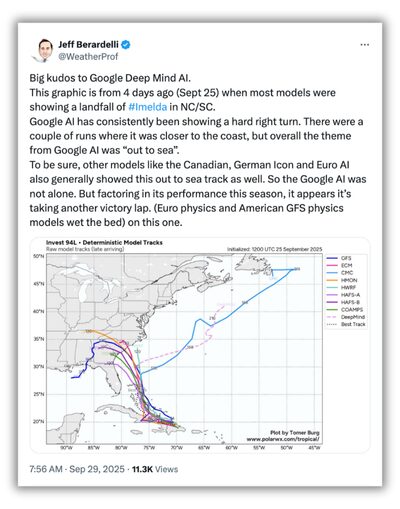
A few days before Hurricane Imelda formed south of the Bahamas, many of the forecast models showed the storm making landfall along the southeastern U.S. coast.
But not Google’s DeepMind GenCast. The relatively new forecast model powered by artificial intelligence showed the storm moving north and then taking a hard right turn, staying away from the U.S.
The American GFS and European ECMWF forecast models, which forecast the weather by solving complex physics equations, eventually predicted a turn away from the U.S., but DeepMind nailed the forecast track even before the storm had fully formed.
“Euro physics and American GFS physics models wet the bed on this one,” wrote Jeff Berardelli on social media. Berardelli is the Chief Meteorologist and Climate Specialist at WFLA in Tampa. “Big kudos to Google Deep Mind Al.”
Predicting the weather has always been a delicate dance between scientific understanding and the unpredictable whims of nature. From sailors searching for a red sky at night to complex supercomputers crunching numeric data, the quest for accurate forecasts drives innovation.
Like many other businesses, much of the innovation today in weather forecasting centers on artificial intelligence. The National Hurricane Center uses it to help forecast the track of tropical cyclones like Imelda. The Storm Prediction Center engages AI to help forecast severe thunderstorms. The National Weather Service is actively testing and experimenting with new AI weather models as part of Project EAGLE. Coordinating the collaboration of AI throughout the agency is NOAA’s Center for Artificial Intelligence.
In addition to Google, leading tech companies such as Microsoft, NVIDIA, and Huawei are also engaged in extensive research and development of AI-driven weather forecasts. All of these leverage vast datasets and advanced machine learning techniques to recognize complex atmospheric patterns that promise to revolutionize weather forecasting with the goal of more accurate and timely predictions.
AI weather forecasting is still in its infancy and not always accurate, as Berardelli points out. However, it offers several significant advantages over conventional forecasting methods, such as:
Improved Short-Term Forecasting AI has the capability to analyze real-time radar, satellite, and ground observations and identify severe weather threats like thunderstorms and flash floods faster than traditional forecasting methods.
Enhanced Extreme Weather Prediction AI models are being trained on past extreme events, allowing them to better predict disruptive weather and the potential impacts. Ultimately, this gives people in the path of the storms more time to take action.
Faster and More Efficient Model Runs AI models using decades of open-source weather data can produce forecasts in minutes using standard computers. This allows meteorologists to conduct more simulations and deliver updates more frequently.
Bias Correction and Downscaling Most numerical forecast models used today have known biases. Over time, AI can learn those biases and correct for them, leading to more accurate forecasts. AI can also downscale global models and provide local predictions for specific towns and neighborhoods.
AI Resources for broadcast meteorologists
At this time, the data generated by AI-powered forecast models isn’t as readily available as the numerical models widely used today. Most of the data is very coarse, and the models aren’t updated as often as the high-resolution numerical models.
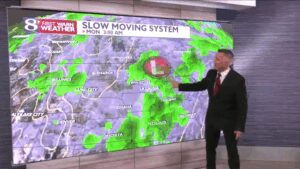 “You’re not going to get the fine details,” says Greg Barnhart, Chief Meteorologist at WKBT in La Crosse, WI. Prior to working in TV, Barnhart was the Meteorologist-in-Charge at the National Weather Service office in Elko, NV, and a weather officer in the U.S. Air Force.
Barnhart says he checks the AI models every day, and he finds them most useful in forecasting long-range weather events. “It’s going to give you general information with a synoptic type of look, that the weather might be unsettled, that you might have showers. You may be able to increase your confidence of precipitation if a lot of the AI models or the ensemble of the AIs are indicating that.”
Here are some AI-powered forecast models that broadcast meteorologists can access right now:
ECMWF’s Artificial Intelligence Forecasting System (AIFS)
Launched on February 25, 2025, AIFS is the world’s first fully operational AI weather model. Developed by the European Centre for Medium-Range Weather Forecasts (ECMWF), AIFS was trained on decades of data. The model runs every six hours and forecasts temperature, wind, cloud cover, precipitation, and more out to 15 days. ECMWF claims AIFS outperforms today’s numerical models up to 20% in some areas, including tracking tropical cyclones, all while using about 1,000 times less energy.
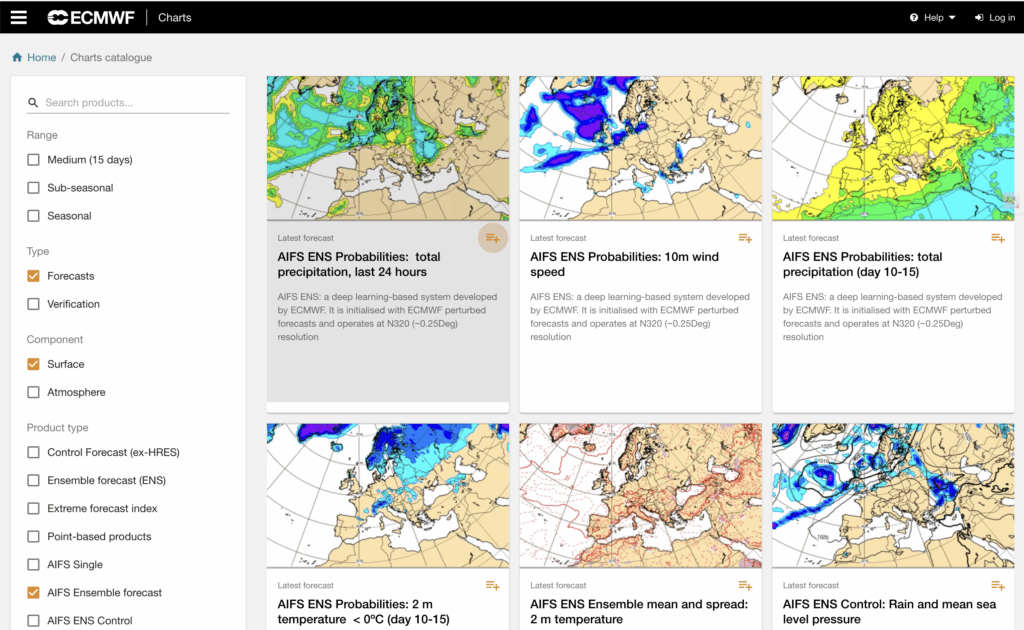
Click here for more information on AIFS and to access model data.
Google DeepMind’s Tropical Cyclone Tracker
The research group at Google DeepMind is developing a new AI model to predict the intensity and track of tropical cyclones. The model, which doesn’t yet seem to have a designated name, introduces random perturbations during the forecasting process. It ultimately produces 50 potential outcomes for each developing tropical cyclone. Although the model is considered experimental, the data is being shared with the National Hurricane Center.
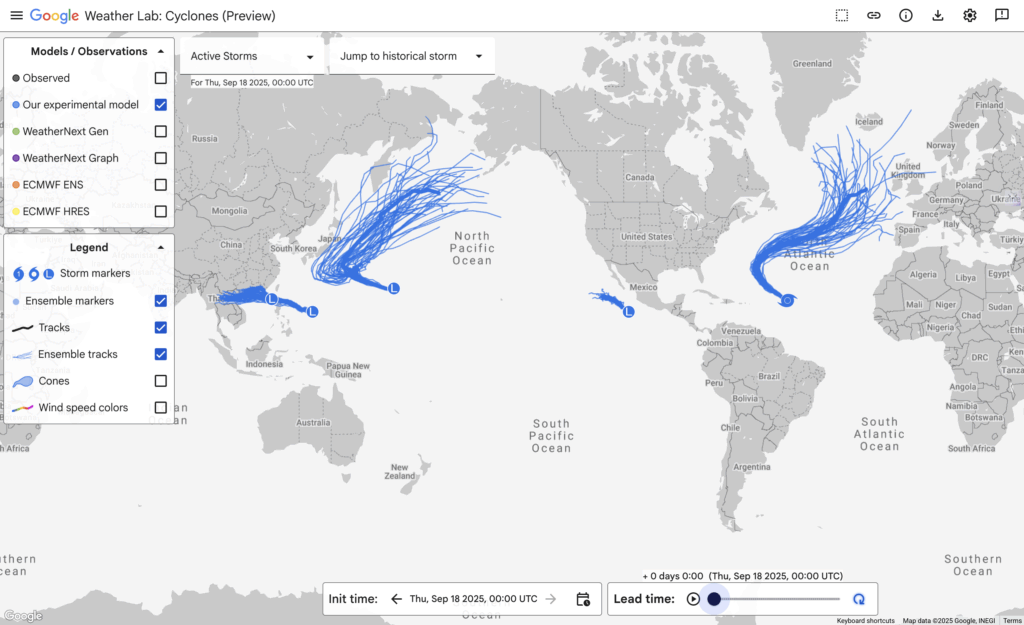
Access the experimental tropical cyclone forecast data at Google’s Weather Lab.
Other AI Forecast Models
Google’s other AI weather model, GenCast, is a newer, more advanced version of the original GraphCast, offering a probabilistic ensemble forecast rather than a single deterministic prediction. GenCast produces 15-day forecasts with uncertainty estimates, which Google says is “a major step towards more actionable, risk-aware predictions.”
Microsoft, NVIDA, and Huawei also have AI weather forecast models that are in research and development. All claim to display “superior performance” over traditional forecast models.
Limited data from each of these experimental AI models is available through the AIFS website.
Forecasting the future of forecasting
Barnhart predicts a future when AI will play an integral role in every forecast. “I don’t see any more development with the current modeling that’s not going to be AI. We’ve reached the saturation point of what you can do with typical modeling without it getting too noisy and messy.”
Will the AI weather forecasts ever get to the point where we can predict a heavy downpour at 4:30 PM on Thursday in La Crosse?
“It may,” Barnhart says. “But it’s definitely not anywhere close to that yet.”
Still, make no mistake. AI is revolutionizing weather forecasting by significantly enhancing accuracy and speed, allowing for more frequent updates and better predictions of extreme weather events, which is crucial for timely on-air warnings. These advanced models also enable clearer communication of risk and uncertainty through probabilistic forecasts using ensemble data. AI also introduces new capabilities such as highly detailed nowcasting and high-resolution weather prediction.
ANOTHER RESOURCE: THE AI WEATHER TOOL
AI weather forecasting doesn’t replace human meteorologists. It empowers them with more guidance that typical numerical modeling can’t provide. There is still a need to keep a “human in the loop” to interpret the data and communicate complex information in a way that the public can understand and appreciate.
The future of weather forecasting is here. And it’s intelligent, fast, and constantly learning. Broadcast meteorologists who embrace these advancements will undoubtedly enhance their understanding of the atmosphere and serve their communities with unparalleled accuracy and insight.
Tim Heller is an AMS Certified Broadcast Meteorologist, Talent Coach, and Weather Content Consultant. He helps local TV stations and broadcast meteorologists communicate more effectively and efficiently on-air, online, and on social media.